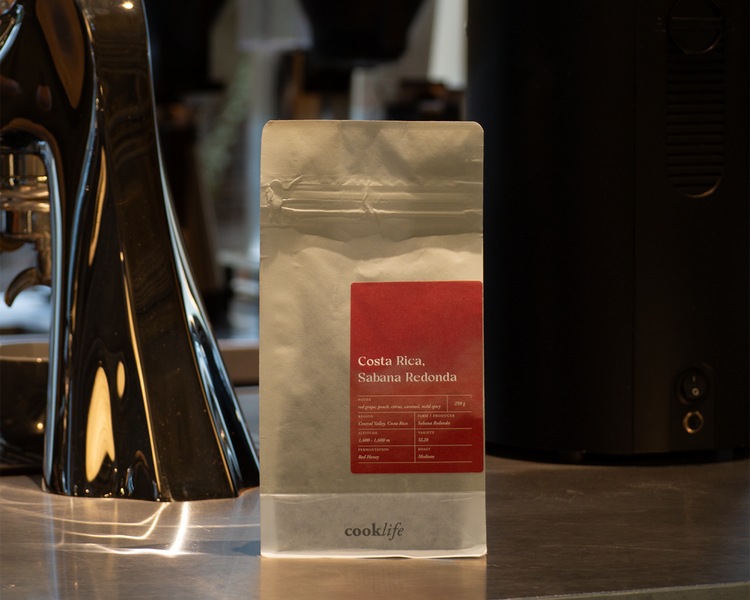


Costa Rica, Sabana Redonda | Red Honey Coffee Bean
- Regular price
- 1,050.00₺
- Regular price
-
- Sale price
- 1,050.00₺
- Unit price
- per
250g
Our coffee comes from the Sabana Redonda lot in Costa Rica’s Central Valley. Juicy red grape sweetness, the soft texture of peach, and a gentle citrus brightness come together in a smooth, well-balanced cup. The natural candy-like sweetness brought by the Red Honey process rounds the flavors without sharpening them. Subtle spicy notes emerge on the palate, finishing with a lingering caramel-like sweetness.
About the Producer:
Sabana Redonda coffees are processed at the Las Lajas micromill, located on the slopes of the Poás Volcano in Costa Rica’s Central Valley. The region’s volcanic soils, mild climate, and shade-grown farming system contribute to coffees with clean flavors and a well-balanced structure.
Las Lajas is a family-run micromill, widely recognized for its commitment to sustainable farming practices, shade-grown coffee trees, and the use of natural fertilizers.
For this lot, the Red Honey process is applied by removing the coffee cherry’s skin while retaining the mucilage layer during drying. After sorting, the beans are laid out on raised beds; keeping them undisturbed during the initial drying phase allows natural sugars to penetrate the bean more effectively. This process, which takes 7–15 days depending on seasonal conditions, enhances caramel-like sweetness, a soft fruit mouthfeel, and delicate spicy nuances.
Tasting Notes: Red Grape, Peach, Citrus, Caramel, Subtle Spicy Notes
Producer: Sabana Redonda
Altitude: 1400–1600 m
Region: Central Valley, Sabanilla de Alajuela
Micromill: Las Lajas
Variety: SL28
Processing Method: Red Honey
Roast Level: Medium
Roaster: Noite Coffee Roastery
About our coffee packages;
- It has the "I'm Green" feature.
- They are sustainable products, do not consume the world's limited oil resources, and are left to future generations.
- During plastic production, no carbon is released into the atmosphere, on the contrary, carbon is absorbed from the atmosphere. In this way, it reduces global warming. (Instead of +3kg oscillation, 2kg absorbs in every 1kg of plastic production)
- As in oil production, nature is not destroyed, forest areas are not destroyed for sugar cane production, unused agricultural lands are rehabilitated and produced by putting them into use. Fair payments are made to farmers during sugar cane production.
- No metal barrier is used in the bags, there is a high oxygen barrier.
Please select the grinding method below.
Couldn't load pickup availability